Let's work together to clean out lakes.
What are Artificial Wetland Islands?
What are Artificial Wetland Islands?
What are Artificial Wetland Islands?

Our Deltona lakes are a vital part of our community and our eco system. Unlike other lakes in Florida, our Theresa Basin lakes do not flow constantly because they are not spring fed. The Theresa Basin relies on rainfall to flow to the St. Johns River. Do to over use of home lawn fertilizers, our lakes have become heavily polluted with nutrients such as nitrogen. DCU wants to help by making AWI's with native plants that consume nitrogen. DCU will provide all the materials from pipe to plants.
What AWIs do:
What are Artificial Wetland Islands?
What are Artificial Wetland Islands?

If you are interested and live on a lake in Deltona; please contact us.
DCU will place a 12 foot by 12 foot square AWI off your shoreline at no cost to you.
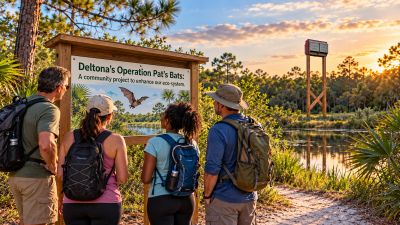
Operation: Pat's Bats
A Community Partnership for a Healthier Deltona
Operation: Pat’s Bats is a proposed community conservation project developed by Deltona Citizens United to support Florida’s native bats while creating educational and environmental benefits for Deltona.
The original concept envisioned one large community bat colony. After additional research, DCU determined that a distributed habitat program would be safer, more practical, and more beneficial. The project has therefore evolved into a plan for carefully placed bat apartments—large, multi-chamber bat houses capable of sheltering substantial colonies—combined with native bat gardens along suitable park trails.
Rather than concentrating bats in one place, Operation: Pat’s Bats would create a network of habitat locations near Deltona’s parks, lakes, trails, and natural corridors.
Why Bats Need Our Help
Florida’s bats face the loss of natural roosting sites, disease, and human disturbance. Trees with cavities, peeling bark, Spanish moss, dead palm fronds, and older structures can all provide shelter, but these features are frequently removed as communities develop.
Bats are also valuable members of Florida’s ecosystem. Florida’s native bats eat nighttime insects, including moths, beetles, mosquitoes, and agricultural pests. Although bat houses should never be promoted as a replacement for professional mosquito control, healthy bat populations can contribute to a balanced ecosystem.
Bat gardens would complement the apartments with Florida-appropriate native plants that support moths and other nocturnal insects on which bats feed. These gardens could also benefit butterflies, bees, birds, and other wildlife while reducing areas of heavily maintained turf.
A Carefully Managed Pilot Project
Operation: Pat’s Bats would begin with one pilot location—not a citywide installation.
Each proposed site would be evaluated for:
- Sun exposure and temperature
- Open and unobstructed flight paths
- Distance from trees, homes, playgrounds, and gathering areas
- Protection from artificial nighttime lighting
- Safe separation from walking trails and parking
- Underground utilities, drainage, and flooding
- Maintenance and emergency access
- Structural stability during Florida storms
Bat apartments would be installed on professionally designed poles or appropriate structures—not attached to trees. They would be positioned so that bats, droppings, and maintenance activities do not conflict with park visitors.
The former community-center property along Lakeshore Drive is one possible pilot location because of its proximity to water, woodland-edge habitat, and existing developed space. It remains only a candidate and would require an on-site professional assessment before any installation.
Public Health and Safety
Public safety will be part of the project from the beginning.
Residents and visitors would be reminded never to touch a bat. Any grounded, injured, or unusually behaving bat would be reported to trained wildlife personnel. The project would also establish procedures for inspections, storm damage, accumulated guano, vandalism, maintenance, and possible human or pet contact.
Educational signs would explain that healthy bats generally avoid people, while also providing responsible guidance about rabies and wildlife contact.
Because Florida bats are protected, all maintenance and management activities would follow Florida Fish and Wildlife Conservation Commission guidance, including restrictions associated with bat maternity season.
Education and Citizen Science
Operation: Pat’s Bats would be more than a construction project. It would create opportunities for:
- Guided evening bat walks
- School and youth conservation programs
- Volunteer garden projects
- Scheduled bat-emergence counts
- Wildlife photography and observation
- Bat-camera programming
- Annual public reports on occupancy and project results
DCU would explore participation in the Florida Bat Force, an FWC program promoting bat education, conservation, stewardship, and participatory science. Trained volunteers could count bats emerging from occupied apartments and contribute observations to recognized bat-monitoring programs.
Could the Project Produce Revenue?
If an occupied apartment eventually produces recoverable guano, the City and its partners could investigate whether it can be safely processed into a regulated soil amendment.
Raw guano would not be handled by the public or sold directly. Any beneficial-use program would require:
- Written City authorization
- Professional collection
- Controlled treatment or composting
- Independent laboratory testing
- Compliance with Florida fertilizer regulations
- Identification of licensed processors and approved buyers
Possible buyers could include nurseries, native-plant growers, and specialty agricultural operations. This remains a long-term research possibility—not promised project income.
Our Goal
Operation: Pat’s Bats is designed to bring residents, conservation organizations, schools, local businesses, wildlife professionals, and the City of Deltona together around a practical environmental project.
The goal is simple:
Preserve habitat. Support native wildlife. Educate our community. Measure the results. Expand only when the project proves successful.
Operation: Pat’s Bats represents the kind of community partnership DCU hopes to encourage throughout Deltona—a project built through research, cooperation, responsible planning, and a shared commitment to a healthier city.
Bee a Good Neighbor Project
Deltona Native Bee Habitat Project.
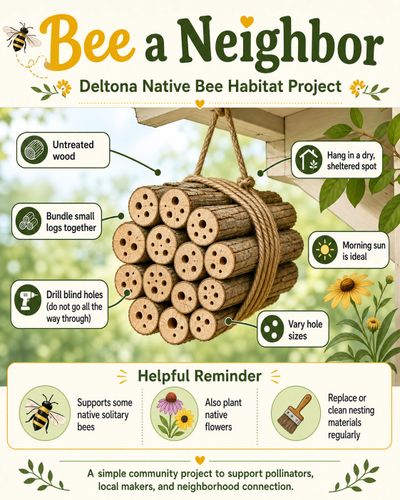
Bee a Neighbor: Deltona Native Bee Habitat Project
What if bringing Deltona residents together started with something as small as a native bee habitat?
We are exploring a simple community-building idea called “Bee a Neighbor: Deltona Native Bee Habitat Project.” The concept is simple: local residents, woodworkers, students, gardeners, civic groups, and small businesses work together to create and share small native bee habitat bundles. A resident or local maker could build them, local businesses could offer them to customers, and families could place them in yards or gardens as part of a broader effort to support pollinators and build community pride.
This is not a government program. It is not a political project. It is a small experiment in civic connection: neighbors helping neighbors, residents supporting local businesses, and Deltona choosing to do something positive together. The “six degrees of separation” idea is that one resident may know a woodworker, who knows a business owner, who knows a gardener, who knows a teacher, who knows a student group — and before long, a simple idea becomes a community effort.
The environmental side should be done carefully and honestly. Florida has hundreds of native bee species, and many do not live in hives like honey bees. UF/IFAS notes that many native bees are solitary, and about 70% of Florida’s native bees nest in the ground, while some may use properly built pollinator hotels. That means bee habitat bundles are only one small part of the picture. Native flowers, reduced pesticide use, bare soil areas for ground-nesting bees, and careful maintenance are also important. Sources such as UF/IFAS and the Florida Wildflower Foundation recommend using thoughtful designs, correct hole sizes, untreated wood, protection from rain, and regular replacement or cleaning to reduce disease and parasite problems.
The larger goal is civic: to prove that Deltona residents can build something useful together without waiting for someone else to solve every problem. A small local product can support pollinators, encourage gardening, help a resident start a microbusiness, bring customers into local shops, and give families a visible reminder that community starts with action.
So the question is simple: Could Deltona build connection, pride, and local cooperation through something as small as a native bee habitat?
We think it is worth investigating.
Bee a Neighbor. Build habitat. Support local. Grow community.
History of Deltona, Florida.
From homesteads to a planned Community.
In 1962, the Deltona Corporation launched one of the largest planned residential developments in U.S. history. Marketed primarily to out-of-state buyers, Deltona was promoted as an affordable, suburban Florida lifestyle community.
Key features of this era:
- Large-scale land platting
- Residential-focused zoning
- Limited commercial and civic infrastructure
- Heavy reliance on county services
Deltona grew rapidly in population but slowly in identity, functioning more as a collection of neighborhoods than a traditional town.
Incorporation and Growing Pains (1995–2010)
In 1995, residents voted to incorporate as the City of Deltona, seeking greater local control over land use, services, and governance.
Incorporation brought:
- A city council–manager government
- Local police services
- Expanded civic responsibilities
It also exposed long-standing challenges:
- Infrastructure lagging behind population growth
- Limited historic downtown or civic core
- Tensions between rapid growth and community cohesion
Deltona in the 21st Century (2010–Present)
Today, Deltona is one of Florida’s largest cities by population without a traditional downtown. Its identity continues to evolve as residents work to:
- Strengthen civic participation
- Preserve remaining historic and cultural sites
- Balance growth with environmental stewardship
- Build a shared sense of place
While Deltona lacks deep colonial-era architecture, its history is no less real—it is the story of modern Florida: land speculation, suburbanization, migration, and the ongoing effort to turn development into community.
Historical Significance in Context
Deltona’s history is unusual but important. Unlike older Florida towns shaped by forts or ports, Deltona represents:
- Postwar suburban planning
- Private-sector city creation
- The challenge of forging civic identity without inherited institutions
Its story is still being written—by the residents who choose to care, participate, and shape what comes next.

A brief history of our area.

Pre-1513 A.D.
Indigenous Florida and First European Contact (Before 1513–1763)
Long before European contact, the region that would become Deltona was home to Timucua-speaking peoples, who lived in dispersed villages along waterways, wetlands, and pine uplands. They relied on fishing, hunting, agriculture, and trade networks tied to the St. Johns River, one of Florida’s most important natural corridors.
In 1513, Spanish explorer Juan Ponce de León landed in Florida, initiating centuries of European claims and conflicts. While no permanent Spanish settlements were established directly within modern Deltona, the region was affected by disease, forced labor systems, and population decline that devastated Indigenous communities by the early 1700s.
3 Nations one Florida.
British Rule, Second Spanish Period, and American Control (1763–1845)
Florida passed briefly to Britain (1763–1783), then returned to Spain before becoming a U.S. territory in 1821. During this period, the interior of present-day Volusia County remained sparsely settled.
Military roads, river landings, and trading routes slowly expanded, especially along the St. Johns River. Conflict during the Seminole Wars (1816–1858) discouraged dense settlement inland, and much of the land that would become Deltona remained undeveloped pine forest and wetlands.
Settlement, Agriculture, and Nearby River Communities (1845–1900)
After Florida became a state in 1845, settlement increased in river towns such as Enterprise, Orange City, and DeLand. These communities focused on:
- Steamboat commerce
- Citrus cultivation
- Timber and turpentine industries
The land within modern Deltona’s boundaries, however, saw very limited permanent settlement. It was used mainly for timber extraction, cattle grazing, and speculative land holdings rather than town development.
Enter the "Modern Era"
Early 20th Century: Quiet Land, Big Changes Nearby (1900–1962)
The early 20th century brought railroads, improved roads, and Florida land booms—but Deltona itself remained largely rural. Nearby cities grew, while this area retained its identity as undeveloped land between established communities.
Drainage projects and highway construction after World War II made large-scale development feasible, setting the stage for dramatic change.
How you can help Deltona with us.
Organize a Community Watch program.
Organize a Community Watch program.
Organize a Community Watch program.

A Community Watch program is an excellent form of advocacy for change that helps improve community safety. By engaging in civic engagement and connecting with your neighbors to build friendships, we naturally begin to look out for one another and report suspicious activity. Let us help you protect your neighborhood while exploring volunteer opportunities to contribute to initiatives like the Old Red Schoolhouse Preservation.
Preserve the "Old Red Schoolhouse"
Organize a Community Watch program.
Organize a Community Watch program.
The 'Old Red Schoolhouse,' built by the Mackle Brothers during the construction of the community center, is a replica of a one-room pioneer schoolhouse where kids can play. Unfortunately, over the years, it has been neglected and turned into an abandoned storage facility for the city. Through our advocacy for change and civic engagement, we would like to see this historic site repurposed as a heritage center. We believe that revitalizing the Old Red Schoolhouse could also provide valuable volunteer opportunities for community members, further enhancing our Community Watch program.
Advocate for Change
Organize a Community Watch program.
Advocate for Change
By uniting our voices, we can engage in effective advocacy for change and promote civic engagement that directs our city towards the future we envision. Initiatives like the Community Watch program and the Old Red Schoolhouse Preservation project, along with various volunteer opportunities, can help us achieve this goal.
Civic Engagement
Advocate for Change
Join us to learn how Florida laws and ethics work to protect us from elected officials who have other plans. Through our Advocacy for Change, we emphasize the importance of Civic Engagement in Deltona, where the government operates as a non-partisan elected office. Decisions made by the government should reflect this non-partisan approach, and our Community Watch program, along with initiatives like the Old Red Schoolhouse Preservation, offer Volunteer Opportunities for all to get involved.
Pedestrian-Traffic Safety
A Deltona School Zone Safety Program pursuant to House Bill 657 (Chapter 2023-174, Laws of Florida), effective July 1, 2023.
This legislation authorizes municipalities to install and operate speed detection systems within designated school zones during active school hours to enforce posted speed limits. The statute establishes clear parameters, including notice requirements, a 30-day warning period prior to citation issuance, and a $100 civil penalty that does not result in driver’s license points. The law was designed to provide local governments with an additional, non-criminal tool to enhance pedestrian safety in school environments.
Deltona Citizens United believes it would be prudent for the City to evaluate whether this state-authorized program could strengthen safety protections for students, families, and school personnel within our community.
Become a Partner
We would love for your business to partner with us or sponsor one of our events that promote Advocacy for Change and Civic Engagement. Let us know how you would like to support initiatives like the Community Watch program or the Old Red Schoolhouse Preservation, and explore the Volunteer Opportunities available to help make Deltona a better place for your business.